
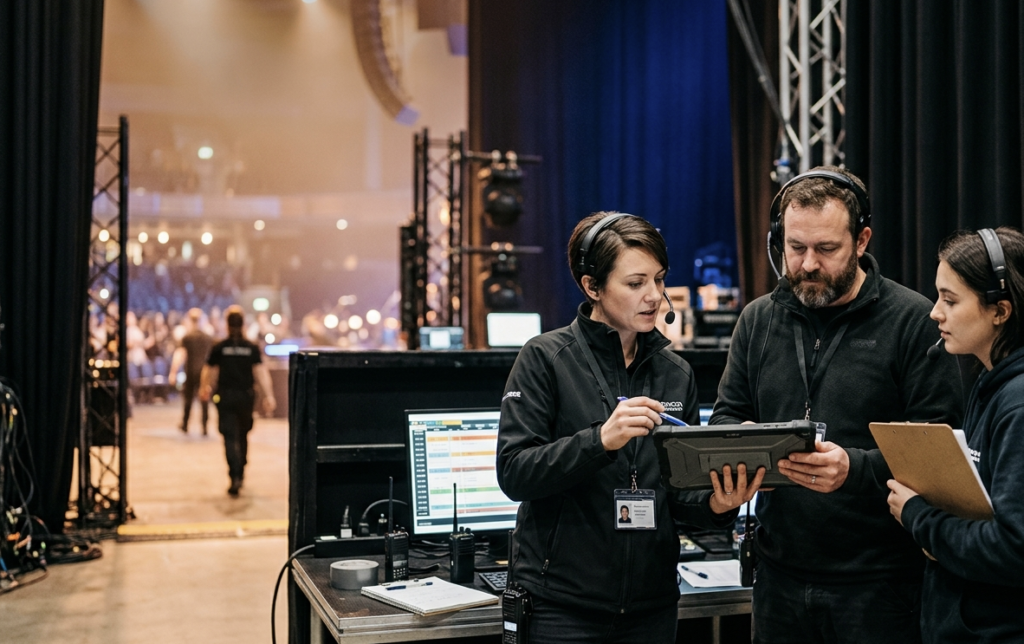

If you’ve spent any time in the meetings, events, or experiential marketing industry, you’ve probably heard someone say it:
“We’ll figure it out onsite.”
Sometimes people say this because the timeline is compressed. Sometimes it’s because everyone assumes another department has already solved the issue. Sometimes it’s simply an attempt to keep the project moving.
The phrase sounds harmless.
Unfortunately, it often becomes one of the most expensive decisions in event execution. After five decades in live event production, I can tell you it rarely ends well.
I’m sharing this because our team at Merestone has delivered thousands of meeting and event productions since 1974, and the pattern never changes. The events that feel effortless were planned relentlessly. The events that felt chaotic were “figured out onsite.”
The problem isn’t the phrase. It’s the mindset.
Live events are unlike almost any other business. There are no do-overs.
The audience arrives. The client walks in. The cameras turn on. The show begins.
Unresolved details get more expensive the closer they get to show day. In pre-production, a problem is a ten-minute conversation. Onsite, that same problem pulls in three departments, burns overtime, and rewrites the schedule.
The venue is simply the wrong place to finish planning. Event execution is where planning pays off, or where the lack of it gets exposed.
Every small issue creates a ripple effect
One of the biggest misconceptions in event production is believing that last-minute decisions only affect one team. In reality, every unresolved detail impacts the entire production.
A scenic delay pushes back lighting. Lighting delays programming. Programming shortens rehearsals. Rehearsal delays reduce client review time.
Suddenly, everyone is reacting instead of executing.
The project hasn’t become more complicated. It has simply become less coordinated. And in event execution, coordination is the whole game.
Why smart teams still fall into the trap
Here’s the uncomfortable part. The people who say “we’ll figure it out onsite” are rarely lazy or careless. They’re usually experienced professionals under real pressure.
Timelines get compressed, so open questions get deferred. Departments work in silos, so everyone assumes someone else owns the detail. And event organizers are natural problem-solvers. We’ve all pulled off small miracles at the venue, so we start believing we always can.
That confidence is earned but it’s also expensive. The teams that pull off miracles onsite are the same teams that could have prevented the emergency in the first place, usually with one earlier conversation.
The fix isn’t another miracle performed at the venue. It’s a culture where every department feels responsible for surfacing open questions early. In that culture, ‘I don’t know yet’ is a planning task, not a problem for future you.
The hidden cost of poor event execution
Ask most people what onsite changes cost, and they’ll say labor. Labor is just the start.
The true cost often includes:
• Additional installation hours
• Overtime
• Rush freight
• Equipment substitutions
• Reduced efficiency
• Increased stress
• Lost client confidence
The math gets ugly fast.
A 2026 Cvent analysis, 390 Event Statistics Shaping the Industry in 2026, authored by Hope Salvatori, shows just how little room budgets have left. Planners now rank rising costs of goods and services as their single biggest concern for in-person events.
With margins that thin, paying rush freight and overtime rates to fix a preventable problem is the most expensive way to spend a dollar.
I’ve watched this exact sequence more than once. The team can’t agree on a scenic finish, so someone says it: ‘we’ll decide onsite.’ The decision finally lands at load-in, but the shop is 2,000 miles away. The fix means rush materials, a local labor call, and an overnight install. The lighting team waits on the wall and the rehearsal starts late. The client’s keynote speaker gets ten minutes on stage instead of forty-five.
Nobody made a big mistake. One small decision just arrived at the most expensive possible moment.
Now run that same pattern through audiovisual, where the numbers get bigger. The same Cvent analysis found that 66% of planners name audiovisual among their largest expense items, second only to food and beverage. When an AV decision gets deferred to load-in day, you’re improvising with one of the biggest line items on the budget.
Labor adds another layer of risk. Cvent’s research also found that 42% of planners say inexperienced venue staff is the greatest impact of ongoing staffing shortages. You can’t control who the venue hires. You can control whether your own production plan leaves room for their learning curve.
Perhaps the biggest cost is the one that never appears on an invoice. When teams spend their time solving preventable problems, they lose the opportunity to focus on delivering exceptional experiences. Instead of creating memorable moments, they’re managing avoidable distractions.
And the stakes have never been higher. A 2025 Splash study cited in the same Cvent analysis found that 52% of marketers attribute at least half of their companies’ closed-won deals to their events. Your event isn’t a party. It’s a revenue engine, and event execution is what keeps it running.
Great event execution starts months before load-in
At Merestone, we believe the best productions feel effortless. Not because they are easy, but because they are exceptionally well planned.
That means asking better questions during discovery, collaborating across departments early, reviewing event logistics and labor plans before load-in, and identifying risks while there is still time to solve them.
In practice, our discovery conversations dig into questions many teams skip.
- What does success look like for the executive sponsoring this event?
- Which decisions are still open, and who owns them?
- What failed at last year’s event, and why? Where does the schedule have zero slack?
Those answers shape everything downstream, from stage design to crew calls. They’re also the difference between a production partner and a vendor who just shows up with equipment.
If that sounds like extra work, consider what it’s worth. Research from GBTA and Cvent, reported in the same 2026 statistics analysis, found that meeting managers who follow an established venue sourcing process estimate cost savings of 22%. Process saves money. It’s that simple.
No event is ever perfect. Weather changes. Freight delays happen. Clients make revisions. Those challenges are part of live events.
Preventable surprises shouldn’t be.
Solve it before the truck doors open: a pre-production checklist
If you want event production planning that keeps surprises off the final invoice, focus on these fundamentals before a single case gets loaded. This is the short version of the event execution checklist our own production teams live by:
• Ask the uncomfortable questions early. Discovery is the cheapest phase of any event. A hard question in week one costs nothing. Save it for the venue and you’ll pay for it in overtime.
• Get every department in one room. Scenic, audio, video, lighting, and creative teams should review the production schedule together, because handoffs are where details fall through.
• Walk the venue on paper first. Load-in routes, rigging points, power, and union rules should be confirmed weeks out, not discovered at the dock.
• Give fabrication deadlines room to breathe. Trade show exhibits and scenic fabrication need shop time, finish time, and transit time. Rush freight is a planning failure you pay for twice.
• Put the show flow in writing. Run of show, cues, speaker transitions, and content deadlines should exist as documents everyone has seen, not as verbal agreements between two people.
• Protect the rehearsal schedule. Rehearsal is the first casualty of onsite problem-solving, and it’s the one block of time that most directly shapes what the audience sees.
• Build a contingency plan you hope to ignore. Weather calls, backup equipment, and alternate schedules only help if they exist before you need them.
None of this is glamorous. All of it is cheaper than the alternative.
The difference clients can feel
Clients may never see the hundreds of planning conversations that happen behind the scenes. They won’t notice the issues that were solved before anyone arrived onsite.
And that’s exactly the point. The best event execution is often invisible.
When preparation replaces reaction, crews work with confidence, schedules stay intact, and communication improves. The client experiences what matters most: an event that feels effortless from beginning to end.
The same principle carries into every format we produce, from ballroom general sessions to virtual and hybrid meetings to trade show floors. The medium changes. The discipline doesn’t.
That feeling is also what your audience remembers. Cvent’s 2026 report, 40+ Experiential Marketing Statistics You Need to Know in 2026, authored by John Hunter, cites a Salesforce finding that explains why: 80% of customers consider the experience a company provides to be as important as its products. In experiential marketing, your audience doesn’t separate the brand from the production. A flawless show tells them your company delivers.
A challenge for every event professional
The next time you hear someone say, “We’ll figure it out onsite,” pause for a moment. Ask yourself:
• What decision are we postponing?
• Who else could this affect?
• What would it take to solve this before we arrive?
Sometimes the answer is a five-minute conversation. Sometimes it’s bringing another department into the discussion. Sometimes it’s simply asking one more question. None of it costs a dime in pre-production. All of it decides whether event execution feels calm or chaotic once the show opens.
Those small moments of preparation often become the difference between a stressful production and an exceptional one. It’s the closest thing to a secret that event management best practices contain: nothing impressive onsite happens spontaneously.
And if you lead a team, notice what gets celebrated. When the stories that get retold are all onsite saves, you’re rewarding recovery instead of preparation. Save the applause for the show that ran so smoothly it looked boring from backstage. Nobody had to be a hero, because the plan already was.
Frequently asked questions about event execution
What is event execution?
Event execution is the onsite delivery of everything planned during pre-production: load-in, staging, audiovisual, rehearsals, show calling, and strike. Strong execution depends almost entirely on decisions made weeks earlier. That’s why experienced production teams treat the venue as the place to deliver the plan, never the place to finish it.
What is event production planning?
Event production planning is the pre-event process of translating a creative vision into technical reality: staging, audio, video, lighting, scenic, logistics, labor, and schedules. It gets every department working from the same production timeline, so decisions get made early while they’re inexpensive instead of onsite when they’re not.
What should you consider when planning a corporate event?
Corporate event planning starts with the business objective, then works backward: audience, message, venue, budget, production partners, and timeline. The strongest plans include regular checkpoints where every department reviews the schedule together, plus early confirmation of logistics like load-in access, power, and rigging. The details you confirm in advance decide how smooth the event feels.
What are the stages of the event planning process?
Most productions move through five stages: discovery and objectives, design and budgeting, pre-production planning, onsite event execution, and post-event review. The middle stages deserve the most attention, because pre-production is where risks get identified and removed while they’re still inexpensive to fix.
How far in advance should you plan a live event?
Large conferences and trade shows typically need six to twelve months, while smaller corporate meetings can come together in eight to twelve weeks. Custom scenic and exhibit fabrication adds shop and transit time, so involve your production partner as early as possible. Compressed timelines are workable, but they shrink your margin for error.
How do you measure whether an event was successful?
A successful event is one that meets the objective it was built to serve, so the right scorecard depends on that goal: attendance, engagement, audience feedback, pipeline, or closed revenue. Add event execution to the list as well. Overtime and rush fixes at the venue can quietly eat the return a strong event just earned.
Key takeaways
Extraordinary events don’t come from last-minute saves at the venue. They come from thoughtful planning, proactive communication, and disciplined event execution long before the first truck door opens.
The fundamentals to remember:
• Decisions get more expensive with time, so the cheapest place to solve a problem is in pre-production, and the costliest is the venue.
• Every detail touches every department, because one delayed element ripples through lighting, programming, and rehearsals.
• Process protects budgets, as disciplined sourcing and planning measurably reduce what an event costs.
• The best production work is invisible, and what clients feel as effortless is really preparation they never saw.
Because our job onsite isn’t to figure it out. It’s to deliver an experience our clients can trust, and one their audiences will never forget.
The best time to solve your event’s problems is months before anyone sees it. From corporate meetings to trade shows and experiential activations, Merestone brings 50 years of disciplined event execution to every production. Contact Merestone and let’s plan the show nobody has to save.